-1.jpg)

Pegasus Yachts: Welcome back, Pip, and thank you for joining us. You've just come back from the Aegean 600, sailing double-handed on a Pegasus 50: 600 miles through a competitive fleet, with no shortage of testing conditions along the way. I want to hear how the boat handled under race pressure, what double-handed life aboard was actually like, and whether a yacht built for comfort and short-handed sailing can still hold her own on the racecourse. So, first: what were you expecting going in?
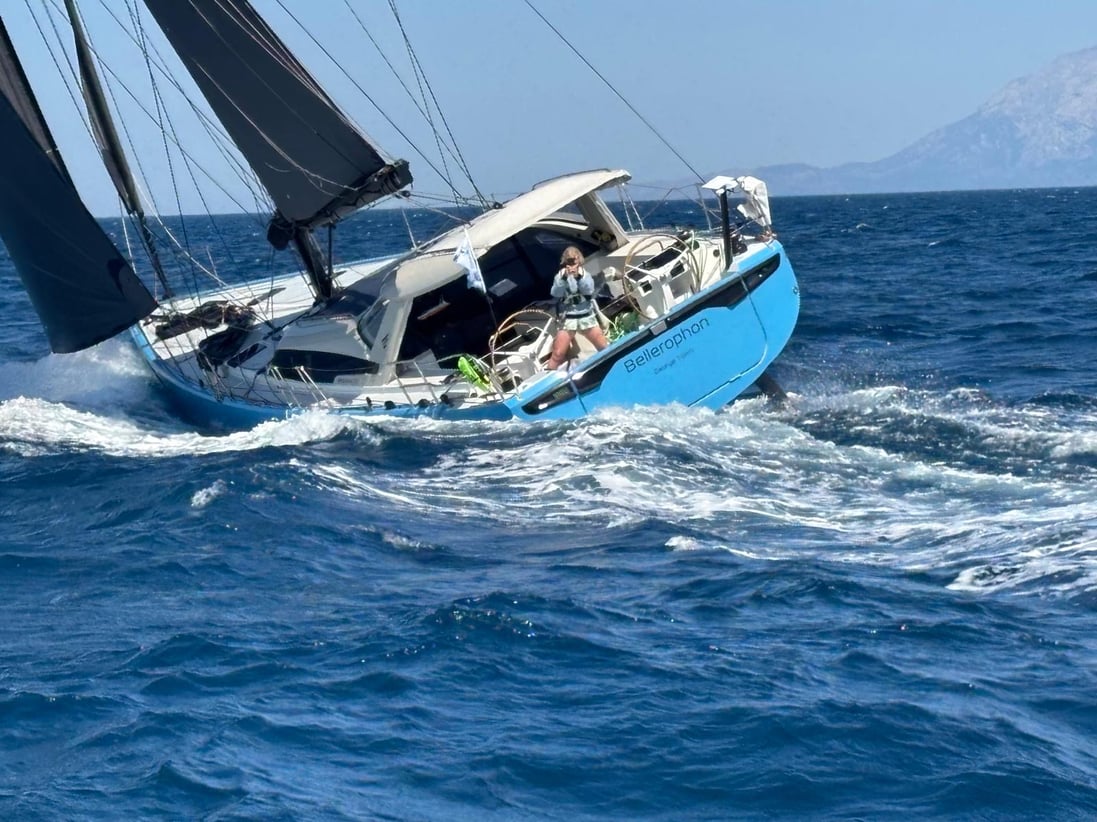
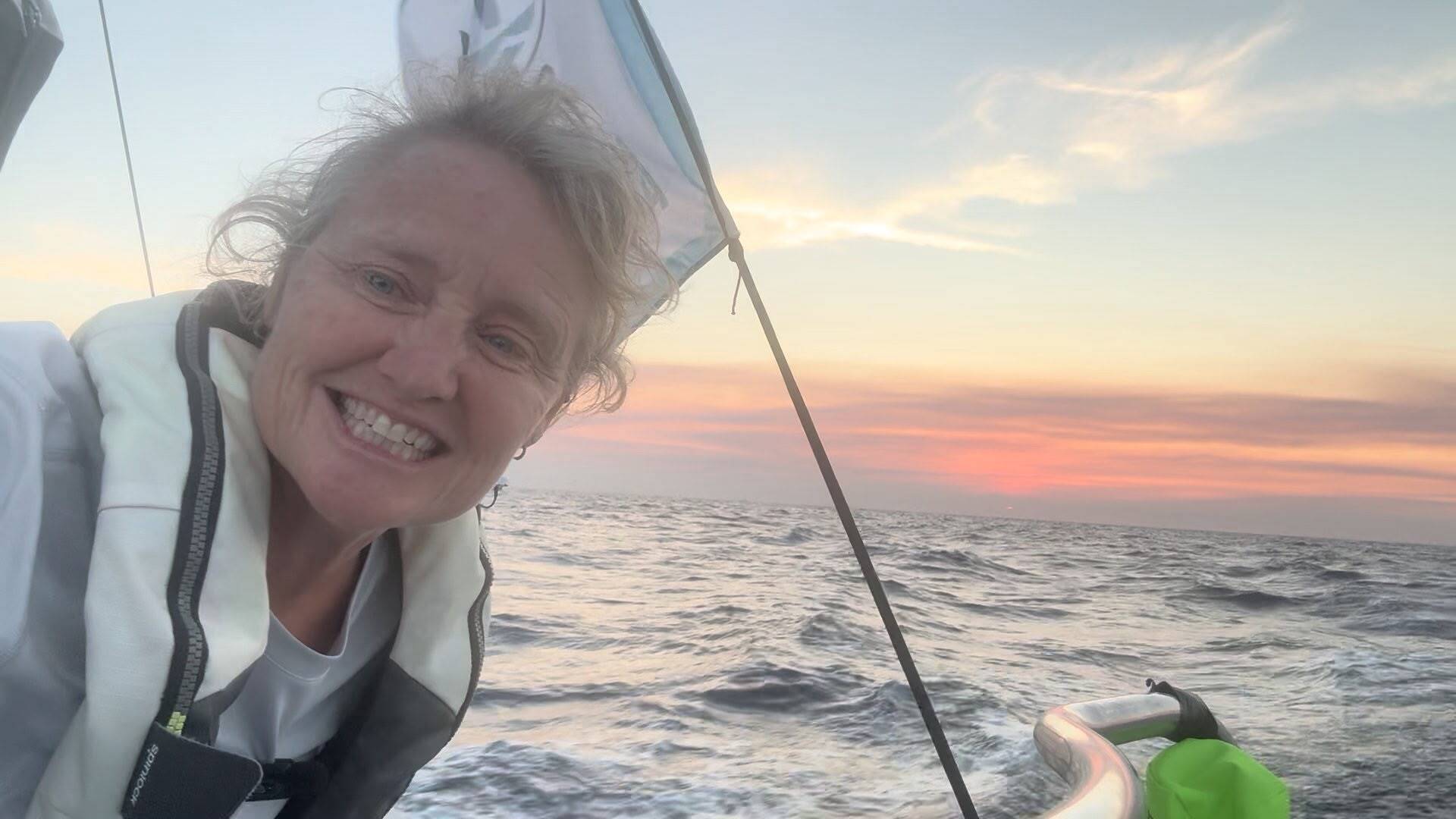
Above: Pip Hare onboard the Bellerophon during the Aegean 600.
Pip Hare: The Aegean 600 was a new course to me, though I'd heard a lot about it. It's gaining real popularity in offshore sailing as one of the 600-plus mile courses around the world, so I was excited to do it. Doing it double-handed adds an extra challenge: any 600-mile course with two people aboard pushes physical ability and, in particular, fatigue. And on a 50-foot boat, that's a fair test.
It was interesting going in. I was focused on the course itself and what it would throw up, but when people asked what I was doing it on, and I said a Pegasus 50, and then double-handed, everyone said the same thing: that's a big boat to manage with two people. So I knew the whole thing would involve a bit of the unknown. But that's one of the great things about sailing: new boats, new people, new challenges. I was looking forward to it.
Pegasus Yachts: How did you prepare the Pegasus 50 for a race like this, and how does that differ from your usual approach?
Pip Hare: Preparation is seriously important before any race, whether it's a stripped-out race boat or a cruiser. But the parameters change depending on the boat and your objectives as a team. One of the important things here was respecting not just the boat, but owner Leslie's own objectives and how far he wanted to push things.
On a stripped-out race boat, you'll spend time removing every piece of unnecessary weight. For the Pegasus, we had to take a practical view, because the boat is set out for bluewater cruising. It has a fantastic interior, thought out so you can live aboard well, not just comfortably: a full set of crockery in wooden holders so it doesn't get damaged going over waves, an amazing coffee machine, memory foam mattresses for every berth. With only two of us aboard and no dedicated storage space on the shore, we couldn't take off every single item just to save weight, so we had to be pragmatic.
.jpeg?width=1920&height=1080&name=WhatsApp%20Image%202026-07-16%20at%2013.37.45%20(2).jpeg)
Above: Pip on watch during the night shift in the Aegean 600 race
We stripped out what we didn't need for racing, the dinghy, outboard, spare anchor chain, without compromising the boat's cruising set-up . Beyond that, it was about making sure everything was secure, which wasn't a big job, since the fit-out on the Pegasus is so well thought through: you don't have to worry about how your wine glasses will stay stowed, because that's already been solved. We left the tools and spares aboard, because on a race lasting four or five days, you need them.
The rest of the preparation was exactly as I'd approach any race: studying the weather, strategising which sails to use and when, practising sail changes and peels, working out the course and when we both needed to be on deck versus when we could rest. You apply the same seamanship preparation to a Pegasus 50 as you do to a 60-footer.
Pegasus Yachts: You mentioned objectives. What were the goals of this race, for you and for Leslie?
Pip Hare: "I joined Leslie as his co-skipper, but really as an onboard coach. He's an experienced sailor but quite new to short-handed sailing, so my role was to coach him in the techniques that work for sailing a boat like this short-handed: sail trim, and a lot around using routing software. I was passing on as much knowledge as I could as we sailed together.
The quality of double-handed entries in the Aegean 600 is very high: purpose-built short-handed race boats, sailors who've won double-handed nationals. Racing with our cruising kit aboard, we needed to be honest about where we could sit. We looked at the double-handed class, found the boats that were cruising boats rather than race boats, of which we were really the only one, and settled on a place in the list we'd be happy with: 7th out of a field of 12."
The Start
Pegasus Yachts: So the start happened. What conditions did you face, and how did the boat respond?
Pip Hare: "The start was in a full meltemi, the northern wind that comes down through the Aegean. We knew it was arriving from the forecast the day before, and like clockwork, it turned up overnight ahead of the start. The biggest challenge for just about every other boat in the marina was simply getting off the dock: it was blowing nearly 30 knots, and marina dinghies were working hard to help push people's bows round. We just cruised off using our bow thruster. First battle won.
Heading out to the line, the breeze kept increasing. There was a short windward leg before a long downwind leg to the first island rounding, so on the way out we discussed which downwind sail to use. We wanted a good start, but in control, and that's where the Pegasus really comes into its own. Starting in gusts over 30 knots, we put two reefs in the main and went with our self-tacking J2. It takes so much labour out when you've got a well-designed, well-cut J2: it's a balanced sail, and tacking becomes just easing the main, tacking, then sheeting in once you've got boat speed. That meant Les was driving while I could be properly eyes-out of the boat, which matters a great deal in a start of that size, with all the IRC monohulls together and, especially in that much wind, a real risk of collision on or just after the start. We felt completely under control and secure: I could watch everywhere around the boat, Les drove, and we went up very comfortably.
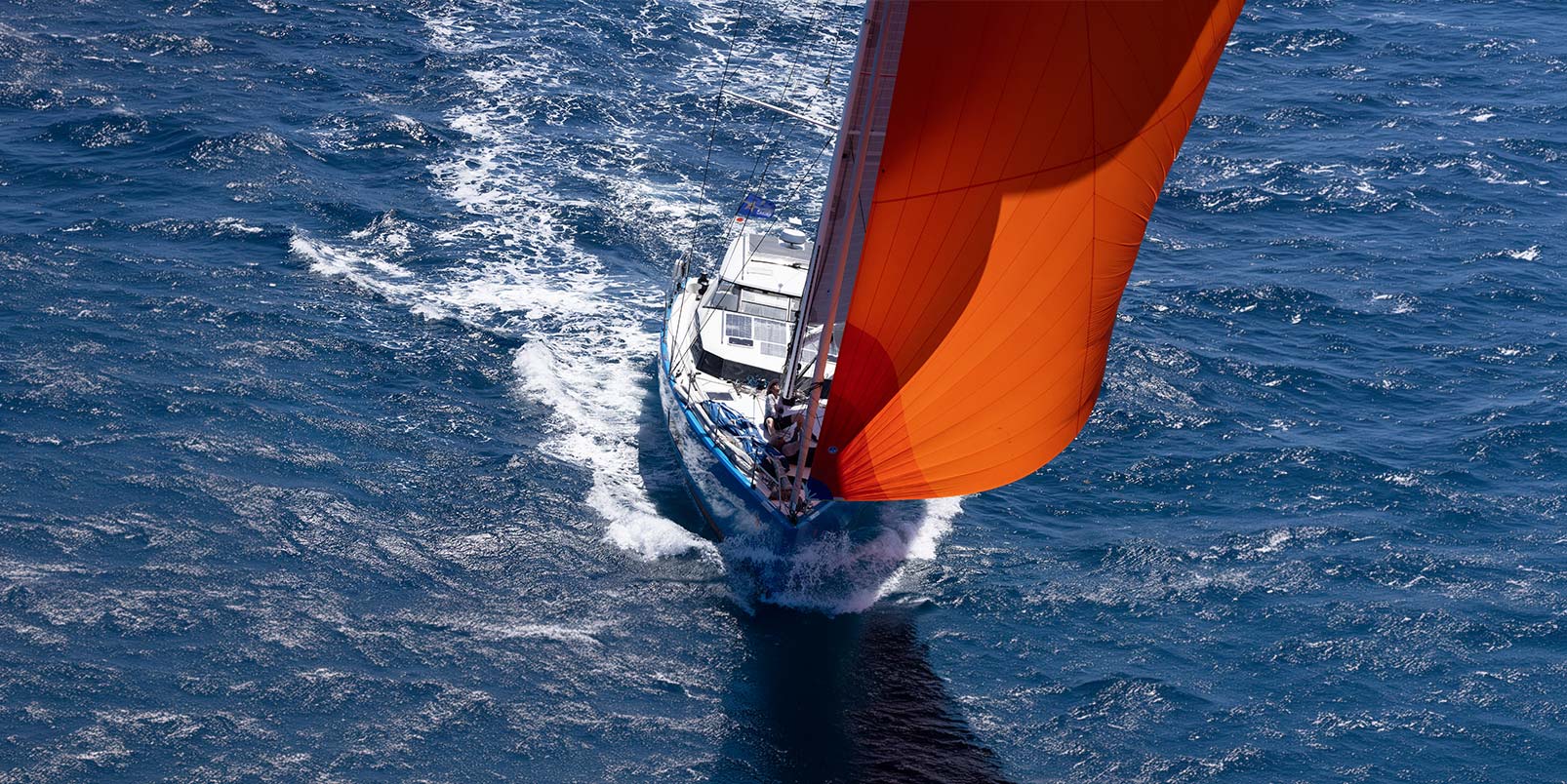
After that, the fun started. It was a windy downwind leg, and we chose our Code Zero, on the more conservative end of what we could have managed in those conditions. But it was the first time Les and I had ever raced together, at the start of a 600-mile race, so we chose control over that extra nudge of performance. It was a great run all the same: the boat surfing at 15 knots, blue skies, incredible seas. There was nothing about that sailing that wouldn't have put a smile on anyone's face.
The Life Aboard
Pegasus Yachts: You spent several days aboard. Where did the boat surprise you, in either direction?
Pip Hare: Going back to that comment before the race, people saying a 50-footer would be hard to manage double-handed. I wasn't massively concerned, having raced a 60-footer single-handed, but for anyone without that kind of experience, which is most people, a 50-footer does seem a big boat for two. Actually, the way the Pegasus cockpit is set out, with electric winches and single-line slab reefing, made it easy to sail with two people, and we weren't just sailing it, we were racing it. We used the J2 a lot and could switch from the J1 to the J2 easily. When we changed sails, they were racing peels, one sail out and another away, properly on the pace, not the "turn downwind and take it slowly" approach.
The reaching speeds were phenomenal. We had performance polars to tell us what speed the boat should manage, and we were almost consistently outstripping our reaching polar speeds by a lot. That showed directly against the fleet: as soon as we hit a reaching leg, we started overtaking people left, right and centre. Really fun sailing.
Beyond that, and I'd say this compared with an average cruising boat, not just what I'm used to, the comfort levels aboard were incredible. We made a lot of use of the gimballed saloon table, dropping it down to form a full berth, so the off-watch person could sleep within easy reach of the cockpit if needed. I'd be dozing there myself and could open my eyes and look over at the big B&G display at the chart table for all the numbers I needed: AIS, everything. It meant I could sleep properly without feeling unavailable to the other person. And I'm now a complete convert to cold drinks on a hot race course. It's a small thing, but it matters.
Pegasus Yachts: Was there a moment where the boat's comfort or safety features made a real difference to how you raced or recovered?
Pip Hare: Most definitely, especially given how hot it was racing in Greece. You lose a lot of energy through heat: it's not just needing to drink more, you become tired more quickly, and your physical and mental capacity drops. Being able to get inside a cool boat, have cold water, even take a shower, made a real difference. You're kind of hardwired not to wash for days when you're offshore racing, but at one point I was covered in salt and sun cream residue and thought, what am I doing, I could just have a shower. I did, and you sleep better and feel better afterwards. That, and the coffee machine (smiles).
.png?width=1080&height=1080&name=WhatsApp%20Image%202026-07-16%20at%2013.37.45%20(1).png)
Above: Since Pip normally avoids coffee altogether while racing, to keep her sleep cycle manageable during microsleeps, she was especially taken with the Pegasus's onboard coffee machine.
Safety-wise, the cockpit is very secure, and there was really no reason to leave it other than to physically change sails on the bowsprit. We were looking at media from other boats: people in open cockpits with huge volumes of water coming through, constantly harnessed on and soaking wet. We were in a secure environment the whole time; it's pretty hard to fall out of a deep cockpit, and the fixed bimini and windscreen kept the spray and sun off us, so very little water actually came into the cockpit. Down below, the sightlines are excellent too: the big screen at the chart table means that if you're off watch and the autopilot is driving, you can go below, make tea, grab something from the fridge, and still see the sails, the horizon, and the AIS. You can properly look after yourself while still racing the boat."
The Result
Pegasus Yachts: Before the race, you predicted a realistic placement of 7th, and that's exactly where you finished. Did that prediction hold steady during the race, or did it shift along the way?
Pip Hare: There wasn't a huge amount of science behind the original prediction, but I went through every competitor: their history, how many times they'd done the race, what boat they were sailing. As I said, lining up against out-and-out race boats, in a way we shouldn't be beating them, because that's not what we are. But I did believe the Pegasus has some real performance characteristics, and I backed Les and myself to make good decisions around the course. That's where the 7th-place target came from.
During the race, we were up to 4th for quite a while, and you can't help wondering if you'll hang on to that. The difference came down to the light wind holes. The Aegean 600 changes direction many times and features long traverses across the leeward side of islands, where there are massive wind holes, so we'd get stuck in the holes a bit longer than others. On the legs without wind holes, though, we climbed the rankings consistently, especially with any reaching involved: clawing back, overtaking, overtaking again. By three-quarters of the way round the course we were sitting in a happy 4th. Then, in the last 100 miles, some big wind holes appeared near mountains rising to 1,000 metres, real snakes and ladders, as we'd call it in the UK. That's where we suffered most. On a course without those big wind holes, I think we'd have been nudging the top five, possibly the top three."
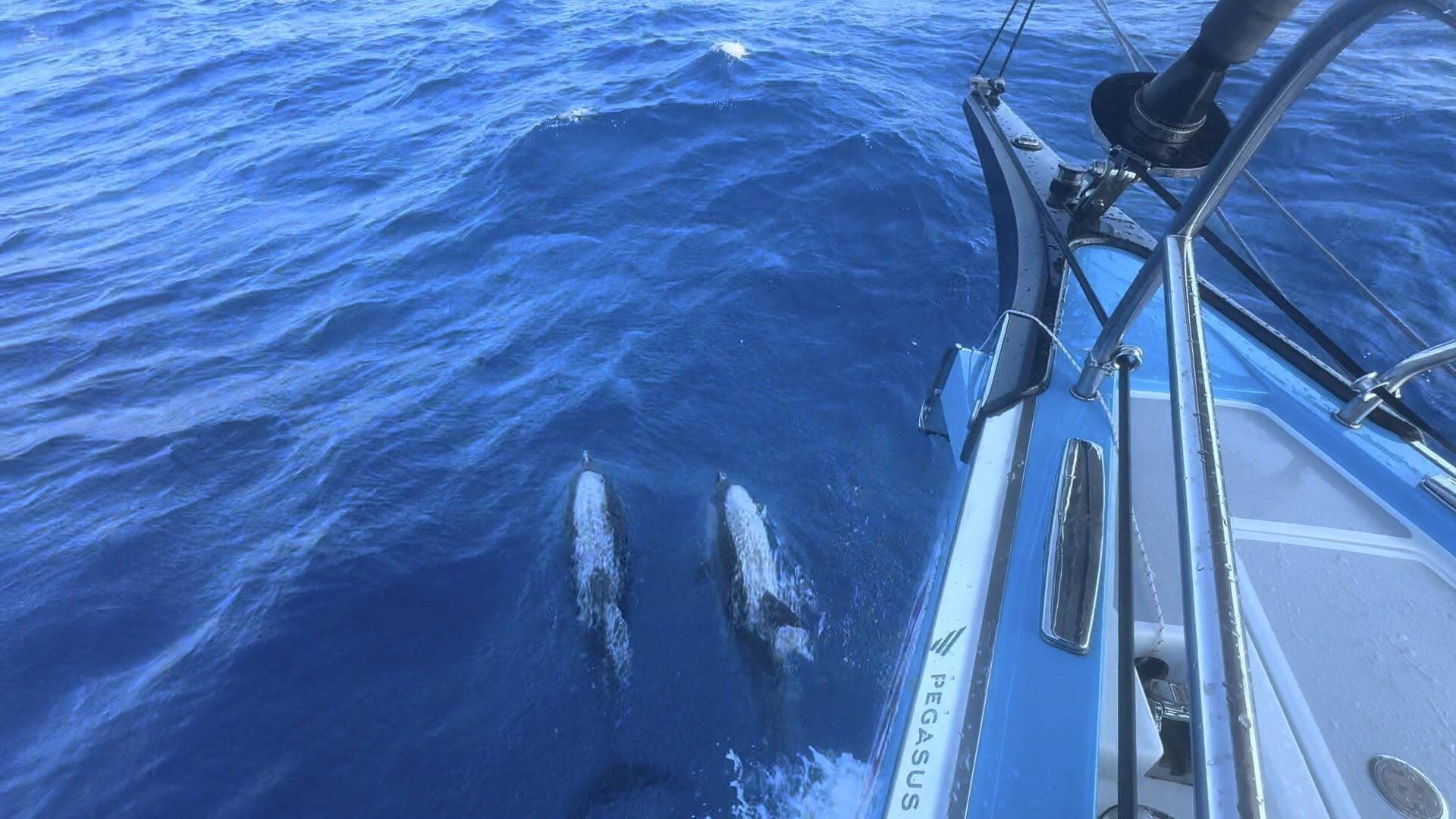
Above: dolphins riding Bellerophon's bow wave during the race.
Pegasus Yachts: The Pegasus 50 is a bluewater cruiser, which clearly affects how she sails in races. Having sailed plenty of cruising boats, how would you describe her performance against others you've experienced?
Pip Hare: The Pegasus 50 feels like a more powerful boat in the way it moves through the water and the momentum it carries. The sail plan really works, and despite that power, it isn't a difficult boat to sail. People sometimes assume a powerful boat will take control of you, be hard to steer or manage, but it isn't: it's very well balanced. We had some challenging sea states, not big waves but very short wavelengths, which is genuinely difficult to sail in, and the autopilot managed it wonderfully. Fun to helm by hand, but the autopilot handled it absolutely.
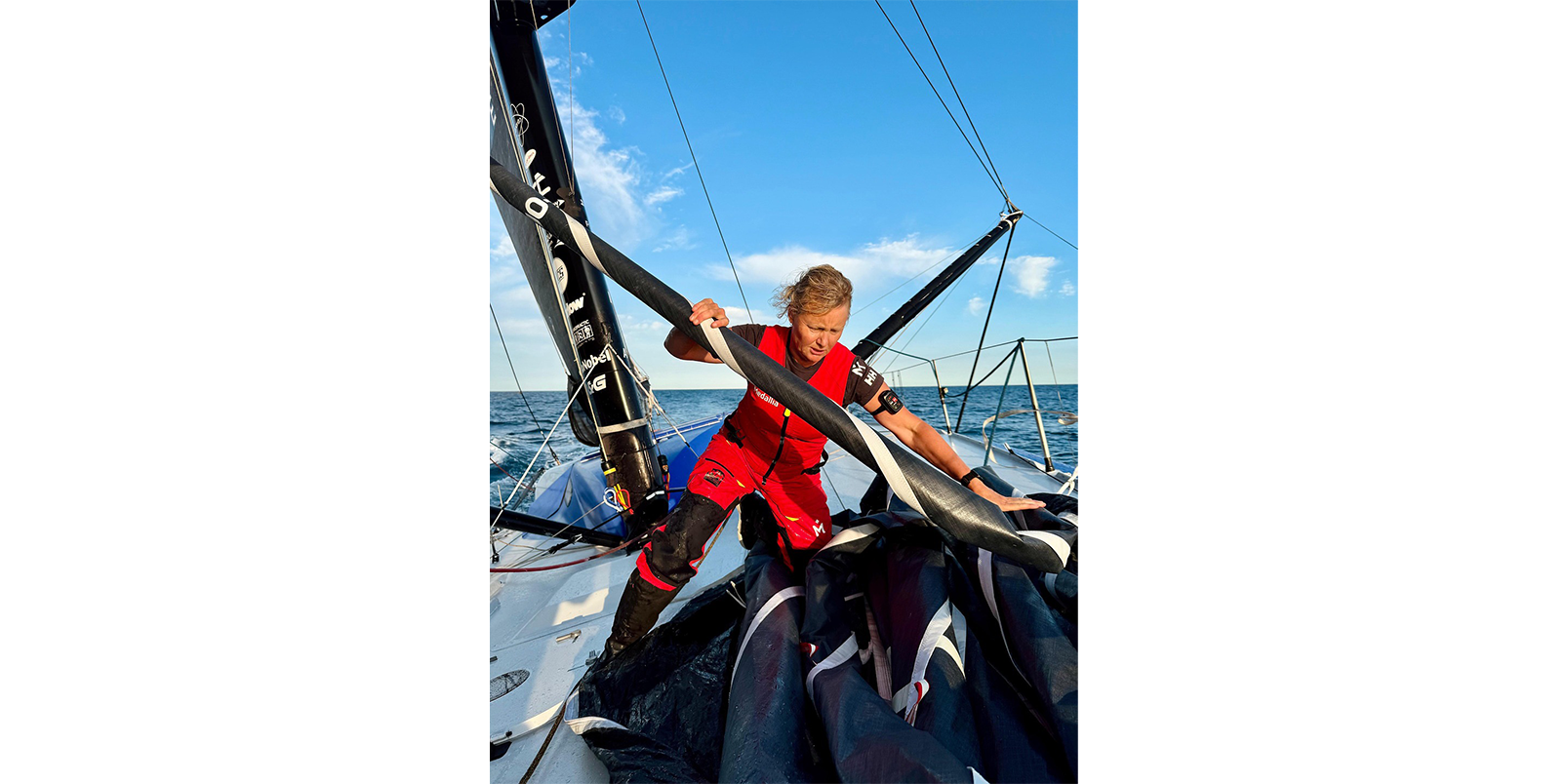
What sets the Pegasus 50 apart from other cruising boats is how adaptable the sail plan is. You can trim it like a race boat, and we had three options for downwind sails aboard Bellerophon, which was fantastic. It's easy to set the J2, easy to set a stay sail too, which is different from other cruising boats, and downwind we always sailed with the stay sail, with the J2 inside it. We also tried using the J1 and J2 together while reaching, which really worked. Fast, and fun.
Pegasus Yachts: One last question: what's your takeaway from this experience?
Pip Hare: We learned a lot along the way. In terms of us, we could have been a bit braver with our downwind sail selection: the boat can really take it, it was helming so well and everything was so under control that we could have gone up a size. But the biggest thing for me was how easily we managed the many transitions and corners of the course. It was a genuinely busy course, and it could have been exhausting, but the standout was how well set up the Pegasus 50 is, not just the sail plan but the cockpit. That doesn't mean you go into a manoeuvre without thought: every manoeuvre still needs preparation, working out your approach, getting your lines ready, and as a sailor you still need to be meticulous. But the boat made those transitions easy, and I think we gained places where the same manoeuvres were more complicated for other crews. That was a real showcase for that characteristic of the boat.
END